

Project details
Title
Series of works: One must imagine Sisyphus happy
Artist
Louisemarié Combrink
Category
Fine Art
This series of works draws on the famous words by the Absurdist novelist and philosopher
Albert Camus:
I leave Sisyphus at the foot of the mountain. One always finds one's burden again. But
Sisyphus teaches the higher fidelity that negates the gods and raises rocks. He too
concludes that all is well. This universe henceforth without a master seems to him
neither sterile nor futile. Each atom of that stone, each mineral flake of that night-filled
mountain, in itself, forms a world. The struggle itself toward the heights is enough to
fill a man's heart. One must imagine Sisyphus happy.
The myth of Sisyphus, from Ancient Greece, tells the story of the devious and immoral tyrant
kind Sisyphus. In his earthly existence, he committed various crimes, greatly angering the gods.
In retaliation, the gods punished him, but Sisyphus cheated death twice during these
punishments. Finally, his last punishment was also his worst: he was forced to roll an immense
boulder up a hill every day, only for it to roll back every time it neared the top. This laborious
and utterly futile action Sisyphus had to repeat for eternity.
In response to this myth, the Albert Camus produced the text Le mythe de Sisyphe, or The
myth of Sisyphus in 1942. Camus reflected on the myth in the larger context of his personal
philosophy of the Absurd, in which he claimed that life risks being futile in an indifferent
universe. Sisyphus’ ridiculous eternal struggle towards nothingness was, for Camus, a
reflection of man’s alien status, of being an exile without remedy; prone to despair.
In search of authenticity, deprived of the memory of a lost home or the hope of a promised
land, trapped in the incomprehensible, man’s only remedy is to relinquish any notion of a
ready-made belief system. A life worth living is found precisely in embracing that which eludes
understanding; to detach from the pursuit of facile meaning, in order to grasp the grandeur of
this life. In the words of Camus:
For if there is a sin against life it consists perhaps not so much in despairing of life as in
hoping for another life and in eluding the implacable grandeur of this life.
Camus imagines Sisyphus as defiant. Amidst the drudgery and ridiculous daily repetition of
the futile, Sisyphus’ weariness is tinged with awareness: this is his freedom.
There are brief moments of respite – walking down the mountain each day, in a deafening
repetition, reminds us of what Gilles Deleuze noted: that no two repetitions are the same.
Sisyphus is free, precisely because of the contradiction between the mundaneness of his
existence, and the extasy of life hidden in plain sight.
A famous insight by Camus regarding the need for life as an act of a rebellion reads thus:
The only way to deal with an untrue world is to become so absolutely free that your
very existence is an act of rebellion.
About the daily toil that risks becoming absurd, and therefore meaningless, Camus says:
I leave Sisyphus at the foot of the mountain. One always finds one’s burden again. But
Sisyphus teaches the higher fidelity that negates the gods and raises rocks. He too
concludes that all is well.
And:
The struggle itself towards the heights is enough to fill a man’s heart. One must
imagine Sisyphus happy.
In this series of works, One must imagine Sisyphus happy, I explore tenets of Camus’
reflections regarding the plight of Sisyphus.
I imagine mundane fragments of counter-narratives, little acts of rebellion, that render
Sisyphus’ happiness concrete. Each day is a fresh start, time without depth, and we put death
in chains in silent victories that fill the heart.
The books I used suggest that the stories are derived from mythical narratives, as we now find
them in print – although these books are eternally stalled in one set of recto and verso pages,
and the story fragments remain as they are for all time.
I imagine Sisyphus looking at dead plants, given to him to incite despair. However, he sees
their beauty and possibility, and this reminds me of Camus’ words:
In the midst of winter, I found there was, within me, an invincible summer. And that
makes me happy. For it says that no matter how hard the world pushes against me,
within me, there's something stronger – something better, pushing right back.
The same happens when Sisyphus notices the clouds of the morning, and finds them beautiful.
In another work, Sisyphus takes tea, and takes pleasure in that simple ritual.
When Sisyphus cries, as one can imagine he does, his tears light up the night in flashes of gold.
Although the gods play with Sisyphus, he finds humour and laughs at the stone.
Neither weight nor lightness can affect Sisyphus, because he exults in his plight – that is his
rebellion.
And at the end of the day, Sisyphus is consoled by the sensation of water cooling his tired feet.
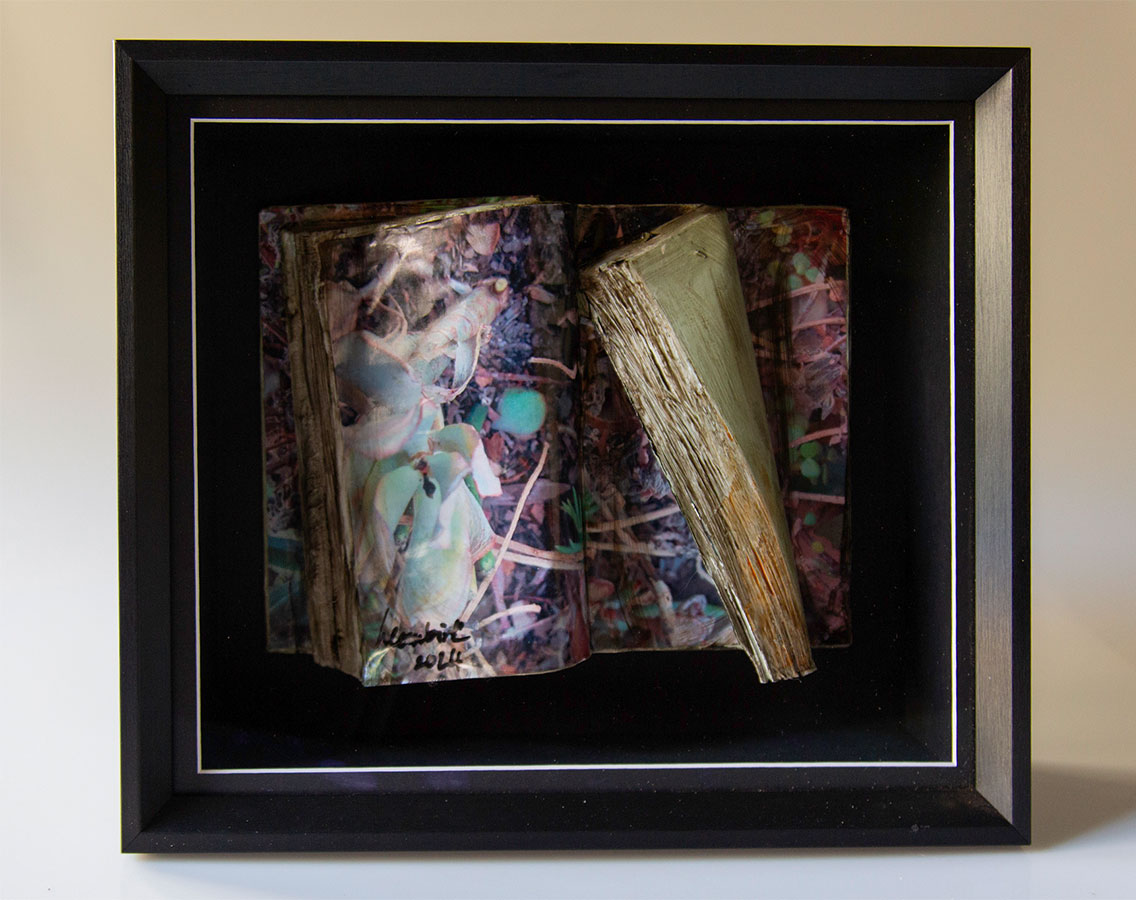 Louisemarié Combrink 2024 An invincible summer Manipulated book, paints (acrylic, enamel, oils), collage 0823760249 louisemarieccc@gmail.com
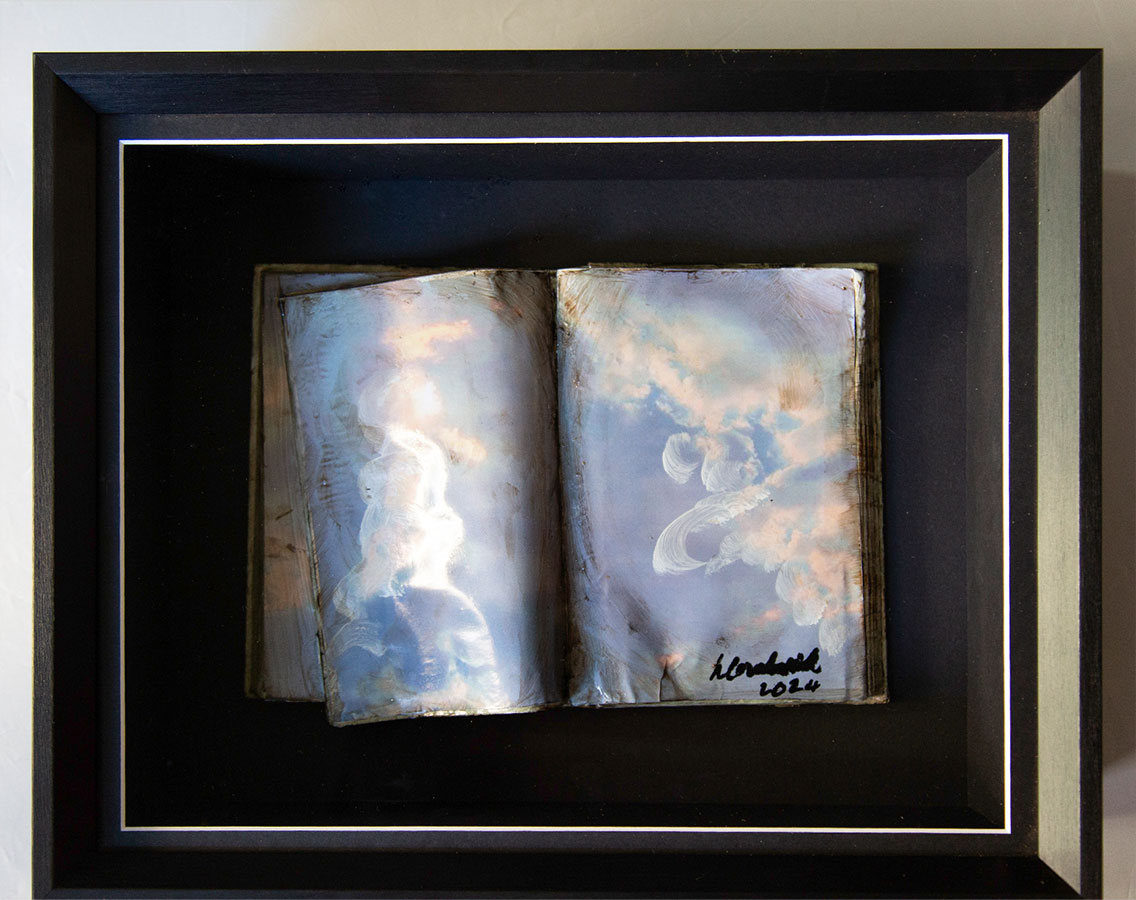 Louisemarié Combrink 2024 Sisyphus sees the morning clouds (they are beautiful) Manipulated book, paints (acrylic, enamel, oils), collage 0823760249 louisemarieccc@gmail.com
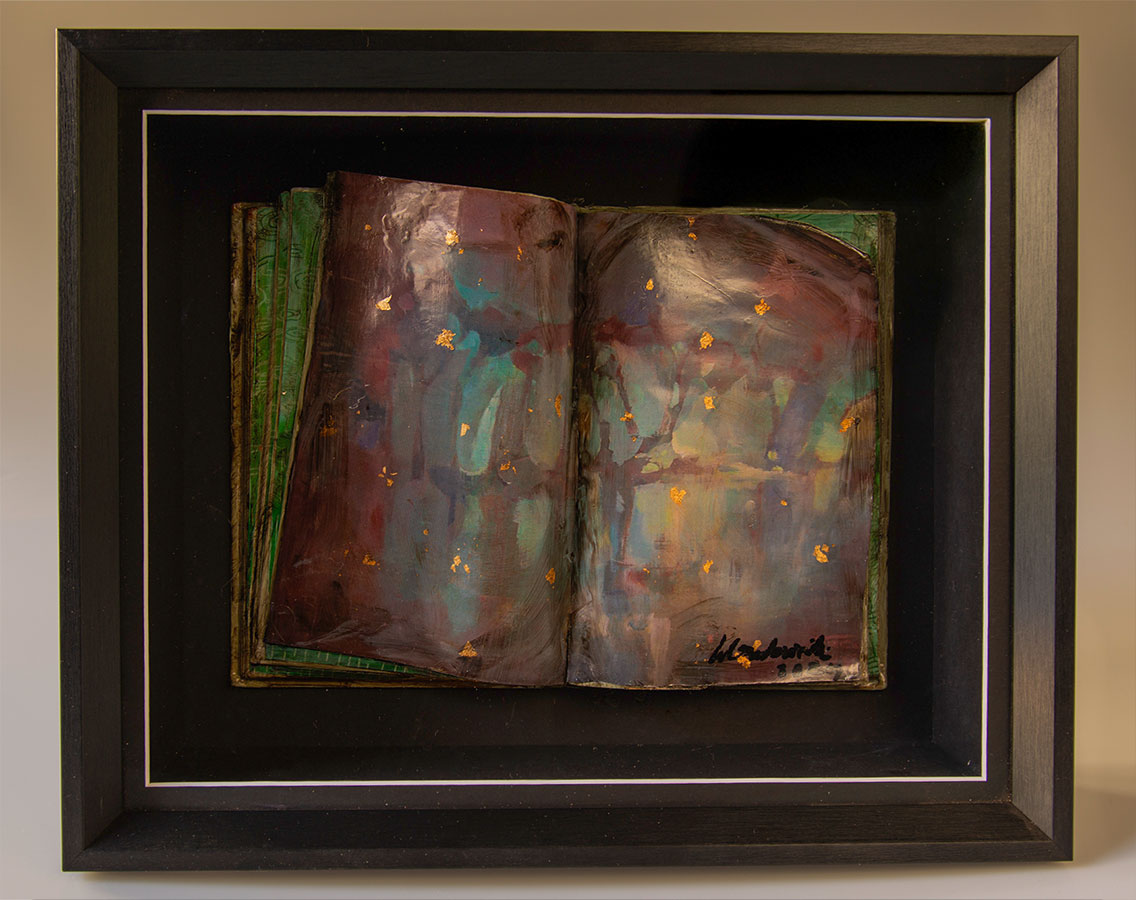 Louisemarié Combrink 2024 Tears of Sisyphus Manipulated book, paints (acrylic, enamel, oils) & gold leaf, collage 0823760249 louisemarieccc@gmail.com
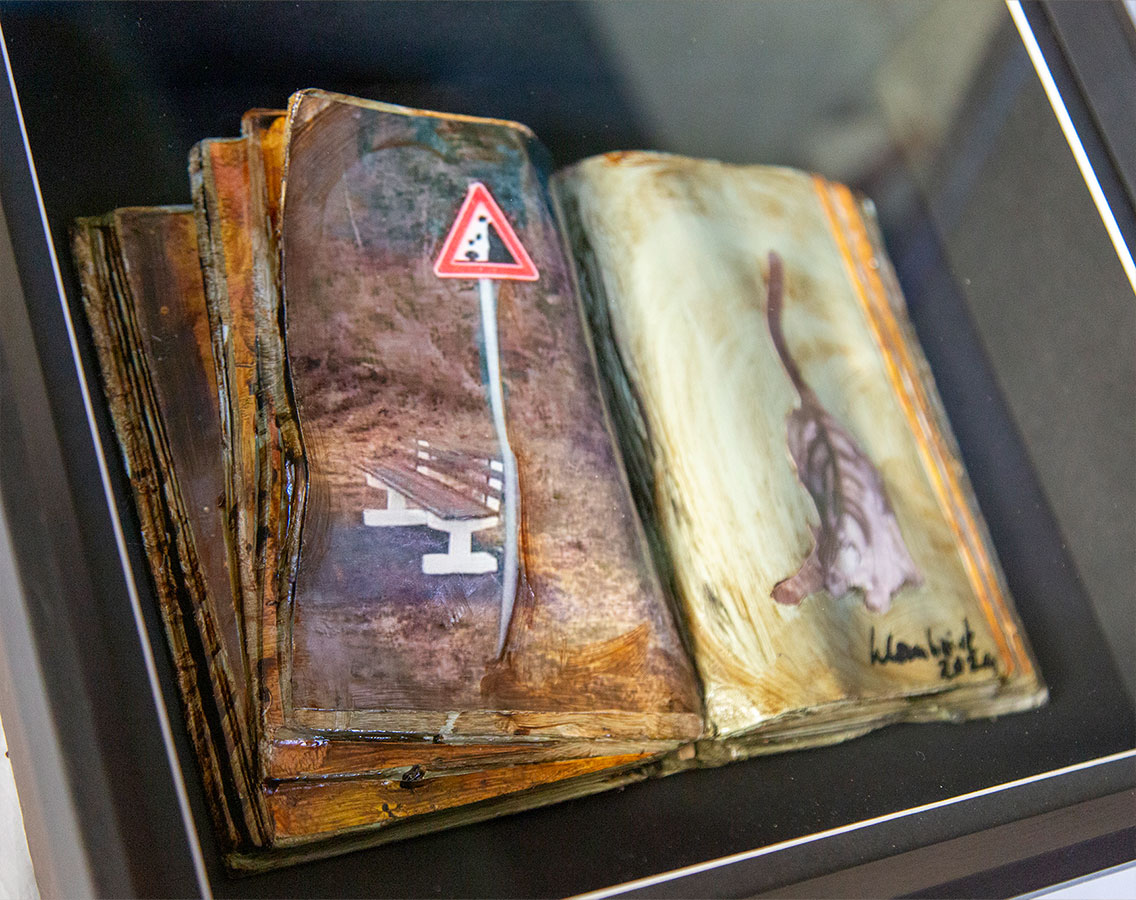 Louisemarié Combrink 2024 The gods play with Sisyphus (he laughs) Manipulated book, paints (acrylic, enamel, oils), collage 0823760249 louisemarieccc@gmail.com
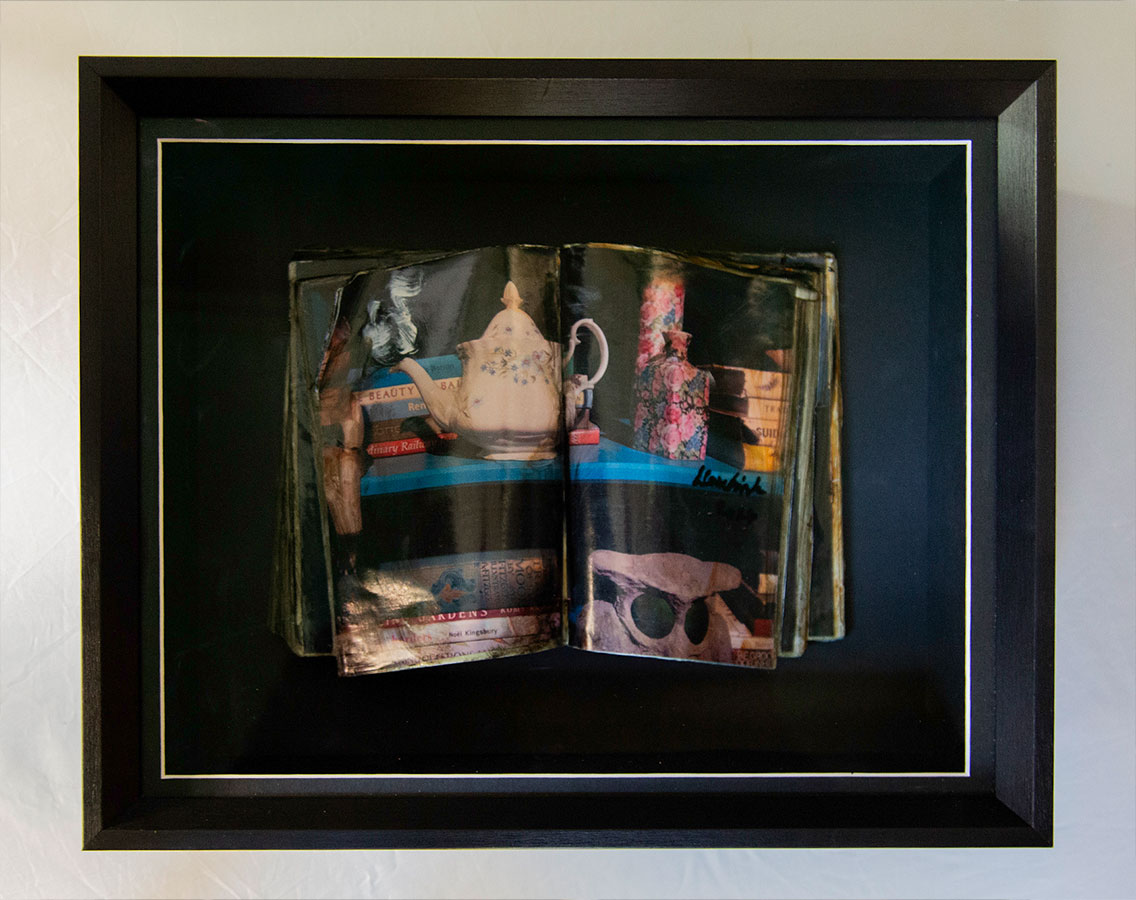 Louisemarié Combrink Sisyphus has tea (it makes him happy) 2024 Manipulated book, paints (acrylic, enamel, oils), collage 0823760249 louisemarieccc@gmail.com
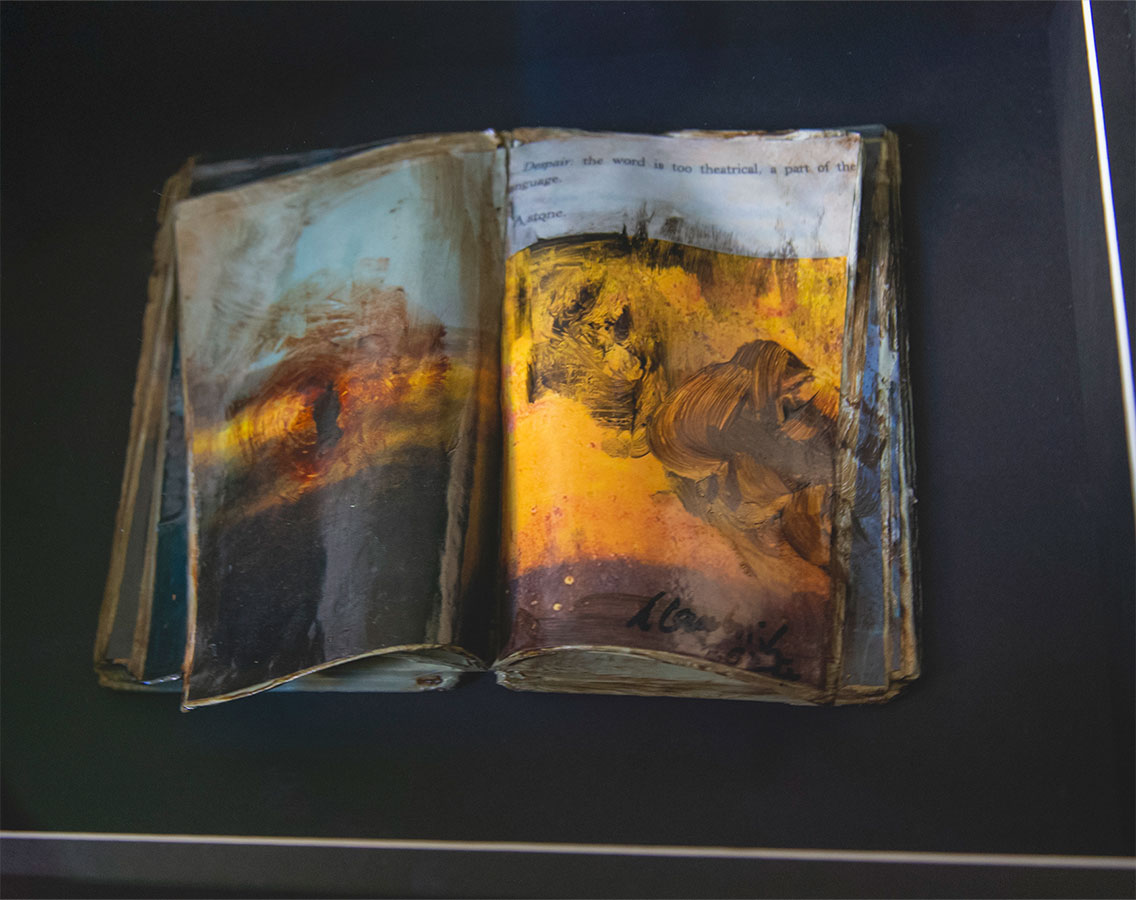 Louisemarié Combrink 2024 Heaviness: still he shall be happy Manipulated book, paints (acrylic, enamel, oils), collage 0823760249
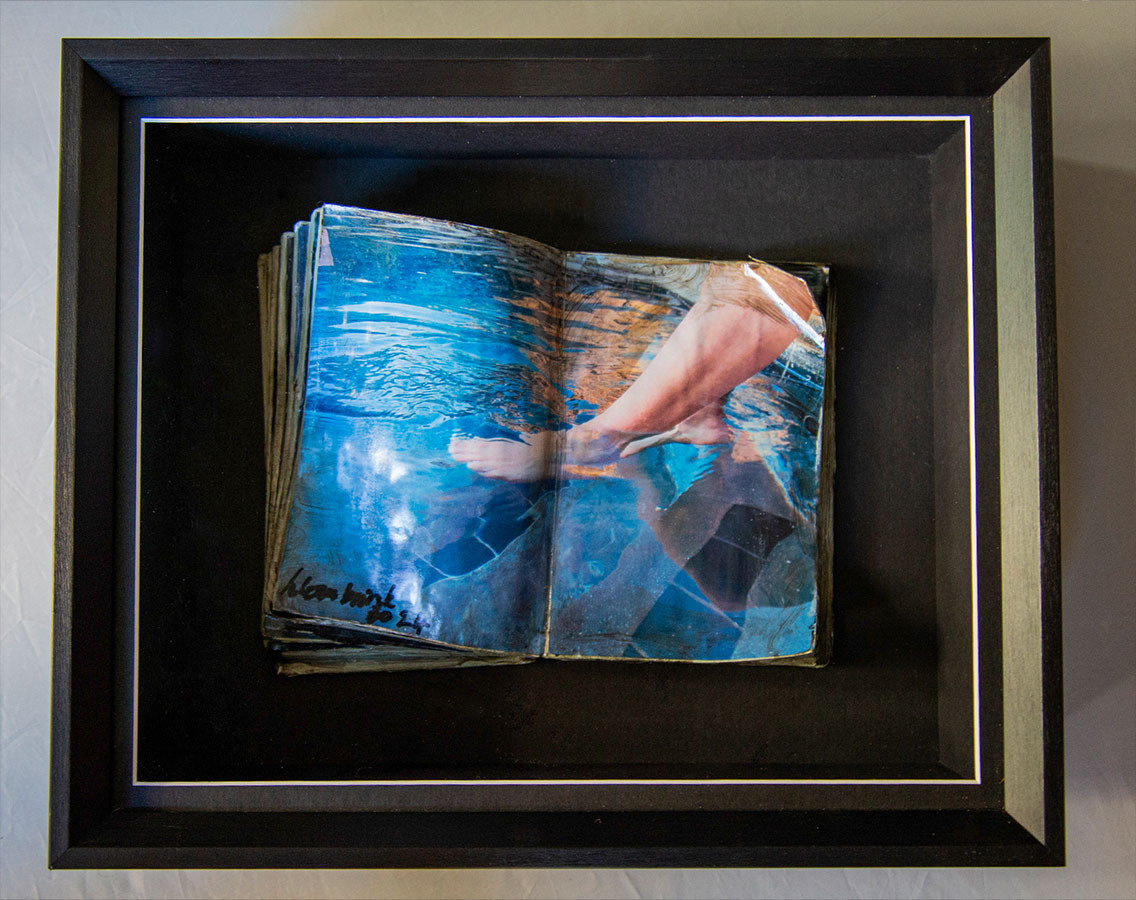 Louisemarié Combrink 2024 Sisyphus rests his feet Manipulated book, paints (acrylic, enamel, oils), collage 0823760249 louisemarieccc@gmail.com